
Powerplay
Handshake-gate and the history of politics in Cricket

Sport and art are often celebrated for offering a level playing field. Innate talent can allow someone with fewer resources to outshine a more privileged player or team. There’s a reason neutral fans cheered Greece’s remarkable run to the Euro 2004 championship or Kenya’s push to the semifinals of the 2003 Cricket World Cup. Moments like these inspire joy and hope in fans everywhere, a reminder of sport’s ideal: merit, effort, and fair competition.
Yet behind the spectacle, money and politics often shape the game and influence key decisions. Power players prioritize self-interest, ensuring that the playing field remains far from level. Today, cricket is largely controlled by the “Big Three”—BCCI, Cricket Australia, and the England Cricket Board. Their influence is evident: all World Test Championship finals are scheduled to be held in England, and nine of the thirteen ICC tournaments between 2017 and 2031 will take place in one of these three nations.
Such influences are not limited to cricket. In 2014, Brazil hosted the FIFA World Cup amid widespread protests over government overspending. With national pride on the line, many felt that refereeing in a physical quarter-final against Colombia, featuring stars like James Rodríguez, was questionable, allowing Brazil to escape a few decisions. Similarly, in the 2019 Cricket World Cup, hosts England faced India in a must-win match in Birmingham on a fresh pitch with a short 58-meter boundary on one side, maximizing their strengths against Indian spinners. Argentina won two FIFA World Cups in the previous century, yet only 1986 is widely remembered in popular culture. From minor preferential treatment (like the first 2 examples) to overt favoritism, money and politics have influenced sports for generations.
Even before the financial boom brought by the IPL, cricket boards often held the ultimate authority. The ICC was originally established as the Imperial Cricket Conference, consisting of just three “white” nations: South Africa, Australia, and England. Since then, the Australian and English boards maintained overwhelming influence. Top players from around the world lined up for county contracts, while stories like Allan Border’s “Raining Rupees” in India, where coins were thrown from hotel windows for the entertainment of visiting players, highlighted the cultural and economic imbalance.
As late as the 1990s, the Australian board reportedly considered “Project Snow,” a plan to call India’s bluff and demonstrate that they could manage without the subcontinent, something the Asian bloc could not reciprocate. Even then, fans from the subcontinent often felt that match referees were more lenient toward Australian and English players. Today, cricket still carries traces of this imperial legacy, with media narratives shaping how the game is perceived: spin-friendly pitches in Asia are frequently vilified, while seaming tracks in England often escape scrutiny.
The concentration of power in the hands of a few boards is nothing new. That doesn’t make it acceptable, but it has long been part of cricket’s history. What is unprecedented, however, is the scale of the BCCI’s overreach in recent years. In the past, if a country didn’t want to play at a particular venue, they simply skipped the match—as Australia did in 1996, or England and New Zealand in 2003. Today, the host nation may be asked to play at a neutral venue because India refuses to visit Pakistan.
Beyond relocating finals to the UAE, when commentators point out India’s advantage of playing in a single venue without travel, former cricketers like Sunil Gavaskar publicly criticize them, claiming that India pays their salaries. It’s gotten so blatant that most journalists who covered the 2023 ODI World Cup hosted by India agree that they had a large say in pitch preparation including the Final where specific areas were kept dry to assist spinners.
When the Pahalgam terror attack occurred, the Indian government was not called to account for the security lapse, nor did the Prime Minister address the press. Instead, public pressure fell on movie stars and sports figures. India’s greatest Olympian, Neeraj Chopra, was expected to make a statement, while retired cricketers playing in the World Championship of Legends had to skip their match against Pakistan. Yet all of this was conveniently forgotten once the Asia Cup arrived.
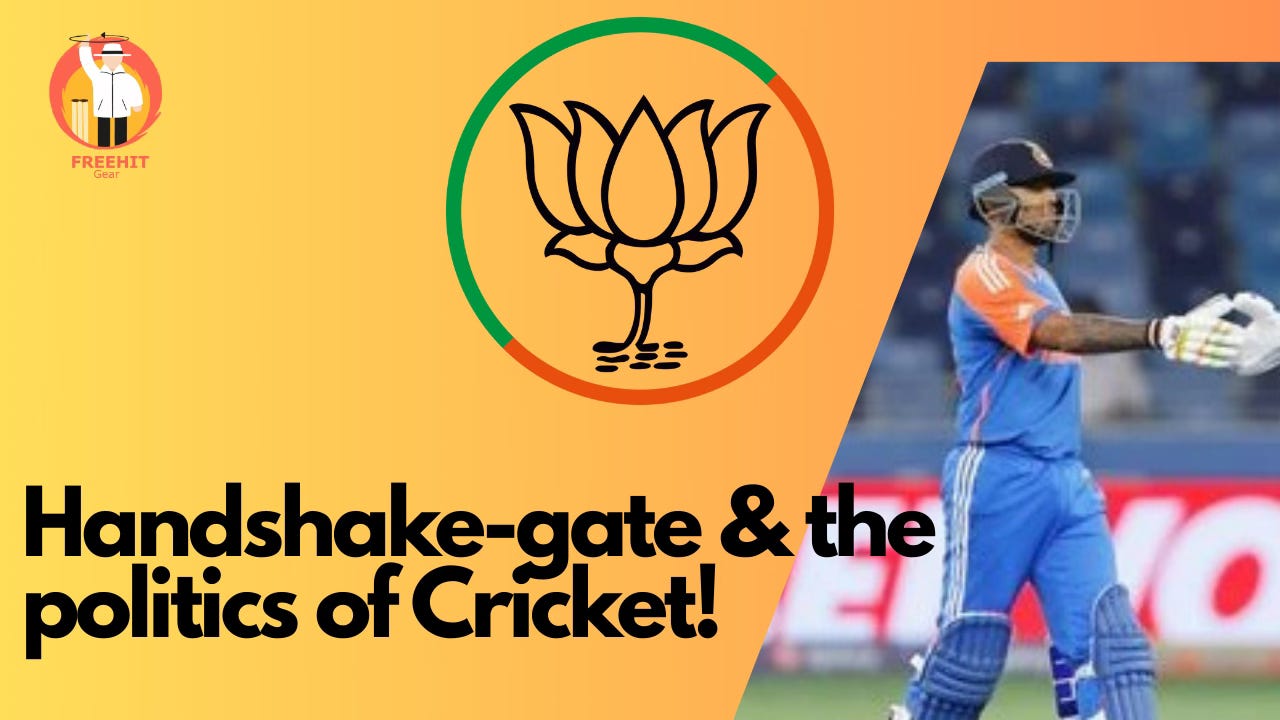
After last Sunday’s win against Pakistan, captain Suryakumar Yadav was asked (I assume) not to shake hands with the opposition and to dedicate the victory to the victims of the attack. Paraphrasing Yadav, love for the country was deemed more important than sportsmanship. Yet no one seemed to inform the BCCI (or the BJP, which approved India’s participation) who scheduled three back-to-back Sundays (two confirmed) for India versus Pakistan matches in prime-time slots. Clearly, generating revenue has become a higher priority than even patriotic symbolism.
Could this Asia Cup have been nearly as profitable without Pakistan? Of course not. Yet India continues to act as if it doesn’t need them. But money is only part of the story. The Indian government also leverages these occasions to stoke anti-neighbor sentiment, fanning hyper-jingoistic flames and asserting perceived superiority. It’s a win-win for them—and if anyone objects, the media apparatus ensures the narrative can be tightly controlled.
At the 1936 Berlin Olympics, African American athlete Jesse Owens won four gold medals, a triumph in front of Hitler, who was promoting Aryan racial superiority. Today, the stakes are far less noble: self-interest and greed are eroding cricket, turning it toxic even for the most loyal fans. Perhaps the only comic relief is that those claiming superiority are often among the least competent, struggling to maintain basic standards like clean stadium bathrooms and to release fixtures and tickets ahead of major tournaments.
Inspirational figures like Owens remind us what sport could and should be. The handshake-gate and the relentless toxicity surrounding every India-Pakistan match are anything but sport—it’s war minus the shooting.
I feel that the revenue point is no longer an incentive to the BCCI… having captured most of the revenue already, it’s simply used to pay for the use of cricket as a political tool domestically. Maybe that was the plan all along, but I doubt such a coherent strategy would have been implemented.