
The Cricket Roundup
On RCB's second WPL title, U-19 World Cup action and the cracking start to the T20 World Cup.

It was an action-packed week for cricket fans. Having missed most of the WPL season and the U-19 World Cup, I was hoping to at least catch the final few games. Frustratingly, both finals fell on a weekday at inconvenient times, making it impossible to watch live. Still, catching up on the highlights, it was clear that the week delivered performances that demanded attention, not just polite applause.
The U-19 World Cup is a tournament I’ve always enjoyed following. The 2018 edition remains a personal favorite, not just because India lifted the trophy under my childhood hero, but because it marked a shift. It was refreshing to see India produce genuine fast bowlers capable of touching 140 kph at such a young age. Fast forward to this edition, and the finalists felt fitting: two unbeaten sides in India and England, both having earned their places with unbeaten campaigns.
India’s 100-run victory in the final may suggest a one-sided contest, but England had their moments. Ben Mayes, who had earlier powered England to a 400-plus total against Scotland, looked in ominous touch once again. Caleb Falconer’s fearless hitting even prompted hope in the commentary box, with Ian Bishop daring to believe despite England still needing 100 runs with just one wicket in hand.
While India boasted several exciting stroke-makers of their own, the tournament’s story extended well beyond the finalists. Afghanistan’s Faisal Shinozada was a standout in the semi-final against India, mixing brute force with deft reverse sweeps to third man. If the 2018 World Cup was about young quicks announcing themselves, this edition was defined by the rapid evolution of power-hitting. That trend has been building for a while - the 2022 tournament saw a handful of 300-plus scores, most of them against weaker oppositions. This time, 380 has been breached four times, India have conceded 310, and England have both scored and leaked totals in excess of 400. The next generation isn’t just skilled, they’re relentlessly aggressive.
And while every major U-19 side seems to have a couple of eye-catching hitters, no one plays this relentlessly aggressive brand of cricket quite like Vaibhav Suryavanshi. The Bihar batter, despite being significantly younger than most of his teammates, looks built differently. His batting evokes memories of a young MS Dhoni - a high backlift, fearless intent, and physique and methods that once felt unconventional. Suryavanshi produced some outrageous strokes that cleared the ropes with ease, but the standout stroke was a tennis-like winner straight down the ground, where his lightning-quick wrists did all the work. A couple of overs later, he used the angles brilliantly to dispatch a near-perfect yorker, showing solid awareness.
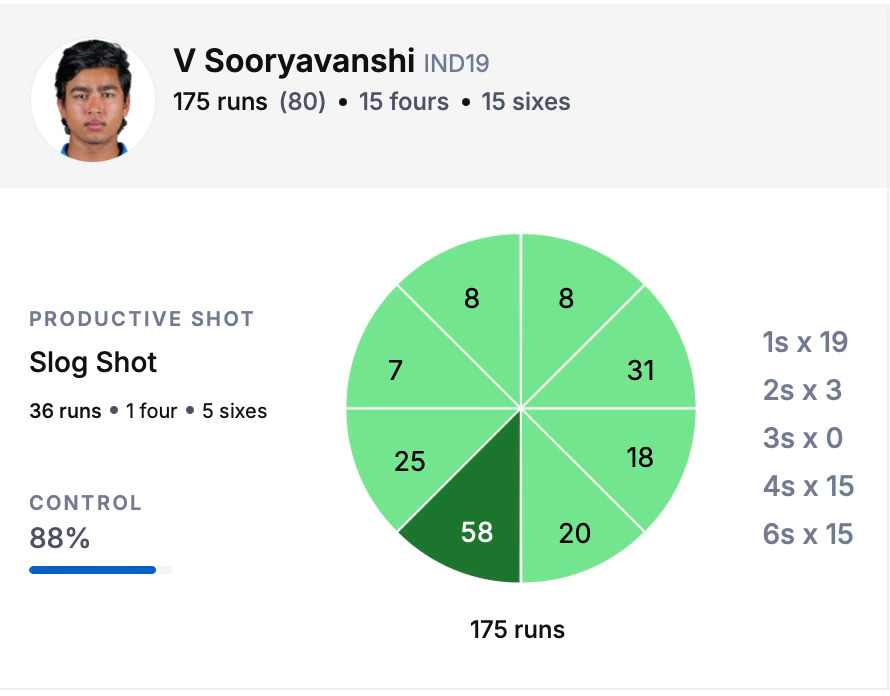
Scoring at that strike rate with 88 per cent control borders on the unimaginable. There was no line or length he couldn’t access, no style of bowling that could rein him in. His bat speed and wrist strength already compare with many senior batters, and he was the clear difference between the two sides. Having raced past 150, he powered India to 250 inside 26 overs by the time he was being dismissed. Without that knock, India would have scored at least 50 runs fewer and England were in with a solid chance. If he plays youth ODIs regularly, it wouldn’t be surprising to see him score 300 on his own when he bats through an innings.
That surge in fearless, power-driven batting wasn’t limited to the U-19 World Cup. The Women’s Premier League reflected the same trend, with growing crowds turning up in strong numbers. Just as encouraging was how that enthusiasm was matched on the field, as batters continued to push the boundaries of what is considered a safe target. RCB capped the season by lifting the title for the second time, chasing down 204 in the final with relative ease. While the contest tightened briefly as Delhi Capitals picked up late wickets, RCB were firmly in control for the majority of the chase. Coming into the season, there were genuine questions about whether they could replicate their 2024 success, particularly following the withdrawal of Ellyse Perry.
Those doubts were answered through smart squad-building. The acquisitions of Grace Harris, Nadine de Klerk, and especially Lauren Bell helped maintain the side’s balance and depth. The standout performer on the night, however, was skipper Smriti Mandhana. Her innings was a near-perfect blend of timing and aggression, striking at over 200 while never appearing rushed. Mandhana has elevated her game in recent times, but this knock stood out even by her high standards, made all the more remarkable given that she played through what RCB Coach Malolan Rangarajan described as a “massive flu”.
Meanwhile, the T20 World Cup has burst into life. The opening two days alone saw nearly every associate side put up a genuine fight, setting the tone for what already feels like a wide-open tournament. The biggest shock nearly came courtesy of the Americans, who reduced mighty India to 77 for six. It took a captain’s knock from Suryakumar Yadav, reminiscent of his superb 68 against South Africa in his first T20 World Cup, to drag India to a defendable total on a surface where the ball was gripping and stopping.
You couldn’t help but feel for the USA. They were already without one of their main batters and vice-captain, Aaron Jones, due to corruption charges, and then saw their death-overs specialist Ali Khan jam his knee on the dreadful Wankhede outfield, ruling him out of bowling any further. With a little more luck, this could have been a monumental upset. Instead, it remains a “what if”, one they’ll hope to revisit another day.
The Dutch were left with a similar sense of frustration after going down to Pakistan by just three wickets in Colombo. Netherlands’ top order batted fluently early on but couldn’t fully capitalize as wickets fell at regular intervals. On a pitch where 156 is the average first-innings score, they were probably 10–15 runs short, yet very much in the contest. Pakistan, too, started brightly before Paul van Meekeren’s superb middle-overs spell dragged the game back into balance.
It was also a joy to watch the evergreen Roelof van der Merwe. At 41, he remains a cricketer who is constantly in the thick of things, his energy seemingly undiminished since that memorable T20 debut for South Africa all those years ago. Needing 29 off the final two overs, and but for that dropped chance off Max O’Dowd, Pakistan might well have become the World Cup’s first major casualty.
While watching Afghanistan in action, I spotted a familiar face among their coaching staff and realised that Toby Radford (whom I had the chance to speak to on The Last Wicket podcast) is now their batting coach. He would have been reasonably pleased with Afghanistan’s batting effort, particularly the smart promotion of Gulbadin Naib. On a freshly laid Chennai pitch, judging a par score was always going to be tricky, but Afghanistan made an immediate impact with the ball, jolting New Zealand early through Mujeeb Ur Rahman’s brilliance.
In the end, though, the Kiwis chased the target with relative ease, taking 54 runs off five overs of Rashid Khan and Mohammad Nabi to swing the momentum decisively. One selection call that may haunt Afghanistan is the decision to go with the inexperienced Zia-ur-Rahman ahead of the widely travelled Noor Ahmad, who has already tested himself across leagues around the world.
If Afghanistan and the Netherlands were left pondering missed opportunities, Nepal were left with trauma. Whether it’s a random ground in Italy during the WCL days or the Dallas stadium in the previous edition, Nepal fans always turn up in force, and this game against England was no different. For large stretches, it felt like a home game. Batting first, England recovered well from early wickets to score at nearly ten an over, with Jacob Bethell and captain Harry Brook underlining their class.
Nepal fought back admirably, led by all-rounder Dipendra Singh Airee, whose two wickets helped restrict England to just 19 runs between overs 14 and 17. Karan KC missed his lengths in the final over, however, and Will Jacks’ clean hitting handed England crucial momentum. At the halfway stage, Nepal looked like long shots, maybe a 30 per cent chance, given their limited experience against major nations. Yet they batted without any sense of inferiority, taking the attack to Luke Wood and Jofra Archer. After eight overs, they were scoring close to nine an over and only marginally behind the required rate.
The middle phase proved decisive. Nepal managed just 34 runs across the next five overs, leaving themselves too much to do at the death. Still, they refused to fade quietly, taking valuable runs off both Adil Rashid and Jofra Archer. Ultimately, Sam Curran held his nerve to secure England’s first win. The game went down to the final ball, and no side will feel more bruised after the opening round than Nepal.
From near-upsets to packed stands and fearless cricket, this opening week has quietly made the case for why a 20-team World Cup feels not just necessary, but ideal. And if you are still not convinced, read this by the PCCI Podcast.

If someone has been out of sorts with cricket recently, I'll share this with them in a heartbeat.