
Where do England go from here?
Ben Duckett's bat angle, Australia's accuracy with the bowl and more from the Ashes.

Ben Duckett’s bat angle
Ben Duckett is currently ranked 14th in the world among Test batters, and among openers, only the prodigious Yashasvi Jaiswal sits ahead of him. He may have endured a couple of ordinary Tests, but at Adelaide the conditions appeared primed for a reset. England bundled Australia out for under 375 and, in oppressive 40-degree heat, enjoyed what was possibly the best batting day of the match. Duckett, surely, was due a big one.
He began his innings as though that expectation would soon be met. His feet moved crisply, the timing was assured, and a sumptuous on-drive off Mitchell Starc was a timely reminder of his class. Then Nathan Lyon intervened, knocking back his off stump with a delivery most off-spinners only dream of bowling. It is hard to be overly critical of a dismissal like that, yet it does highlight an intriguing aspect of Duckett’s technique - one that feels emblematic of modern Test cricket.
Look at Duckett’s setup, particularly the position of his bat as he prepares to meet the ball. At that moment, he appears well placed to nearly middle it, or at worst produce a thick edge. The bat is perfectly vertical, and rather than reaching for the ball, he seems content to wait for it to arrive.
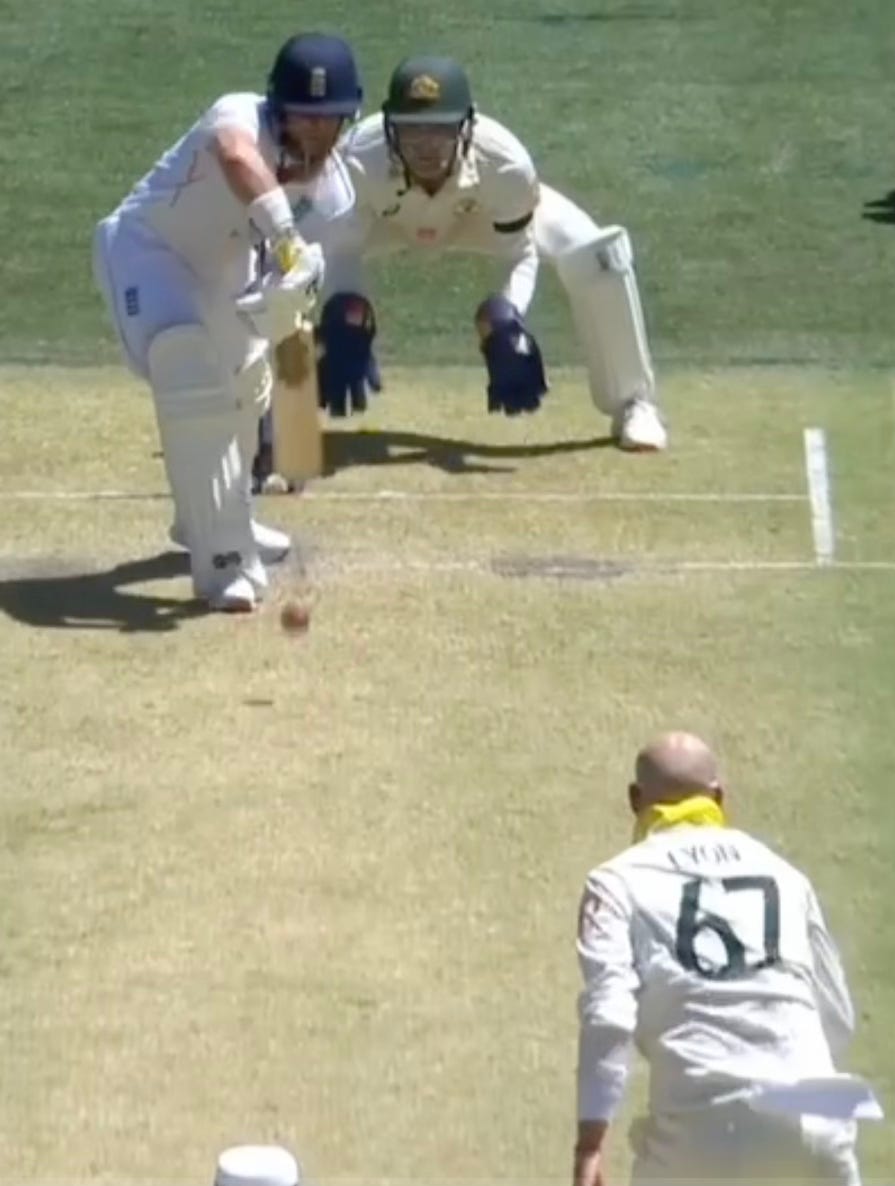
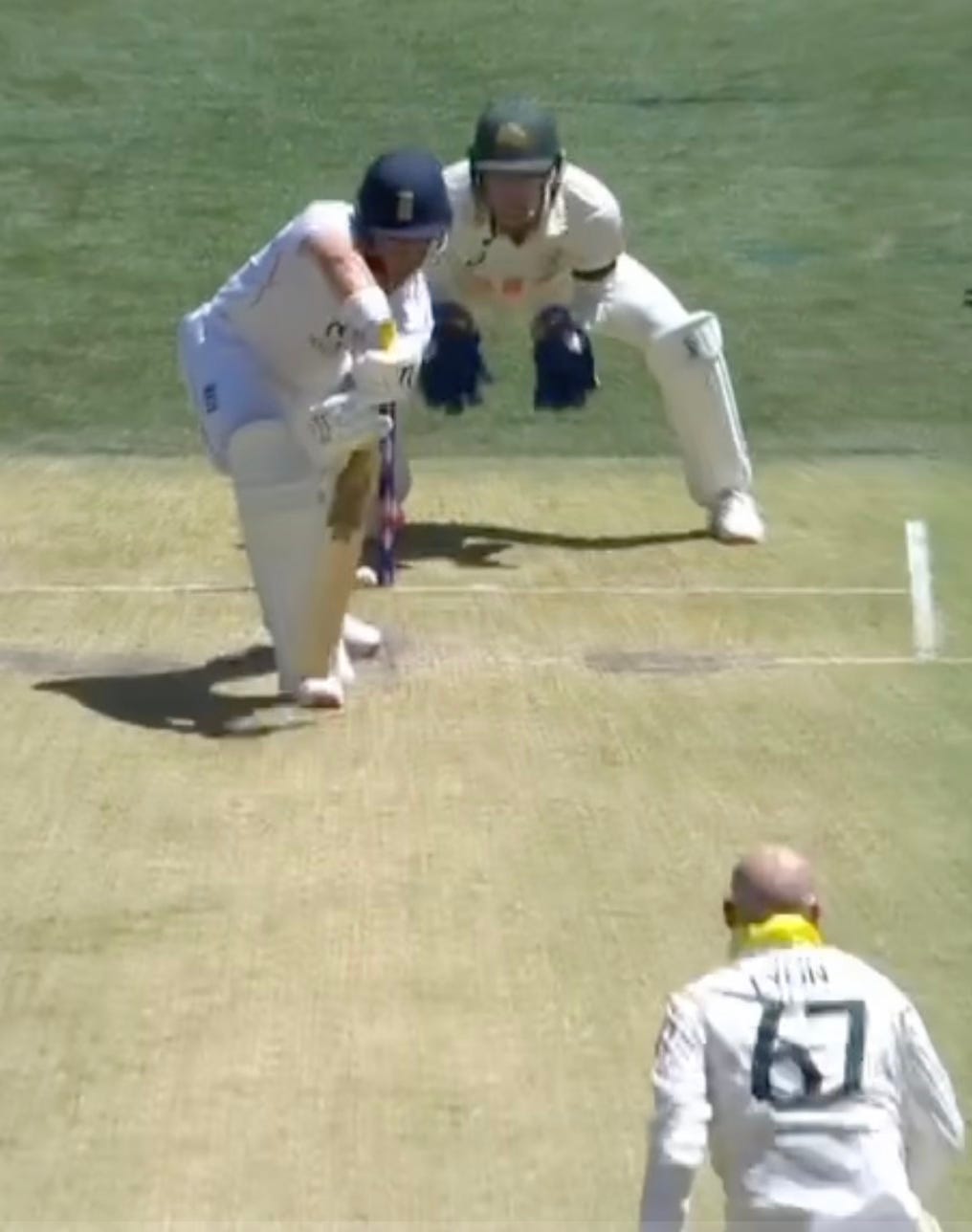
The second screenshot shows why he ends up missing the ball altogether. Duckett prods with the bat slightly in front of his pads. This is largely a consequence of the DRS era as confirmed by former players like R. Ashwin. They have repeatedly pointed out that the old-school method of keeping bat and pad aligned has become obsolete, particularly against spin, as it dramatically increases the risk of LBW. That adjustment, in itself, is hardly unique. What is notable, however, is the angle of the bat.
That bat angle is reminiscent of Cheteshwar Pujara. India’s former No. 3 suffered a handful of dismissals where he was nearly in line with the ball, yet it passed the outside edge due to the bat’s angle rather than poor judgment of line. My sense is that this is not a flaw so much as a compromise: a blend of personal habit and a modern batter’s reliance on late wrist adjustments. It allows for last-second corrections when the ball seams or drifts more or less than anticipated - but every so often, it comes back to bite the batter.
A chasm in bowling class
As England walked out to bat on Day 2, my instinct was that the sheer talent in their line-up would finally translate into a meaningful performance. Australia’s 371 felt slightly under par to most analysts and commentators, as they suggested the hosts had left runs out there. The conditions were good for batting and, despite the obvious superiority of Australia’s bowling attack, I expected England to mount a proper fight and keep the series alive for at least another day.
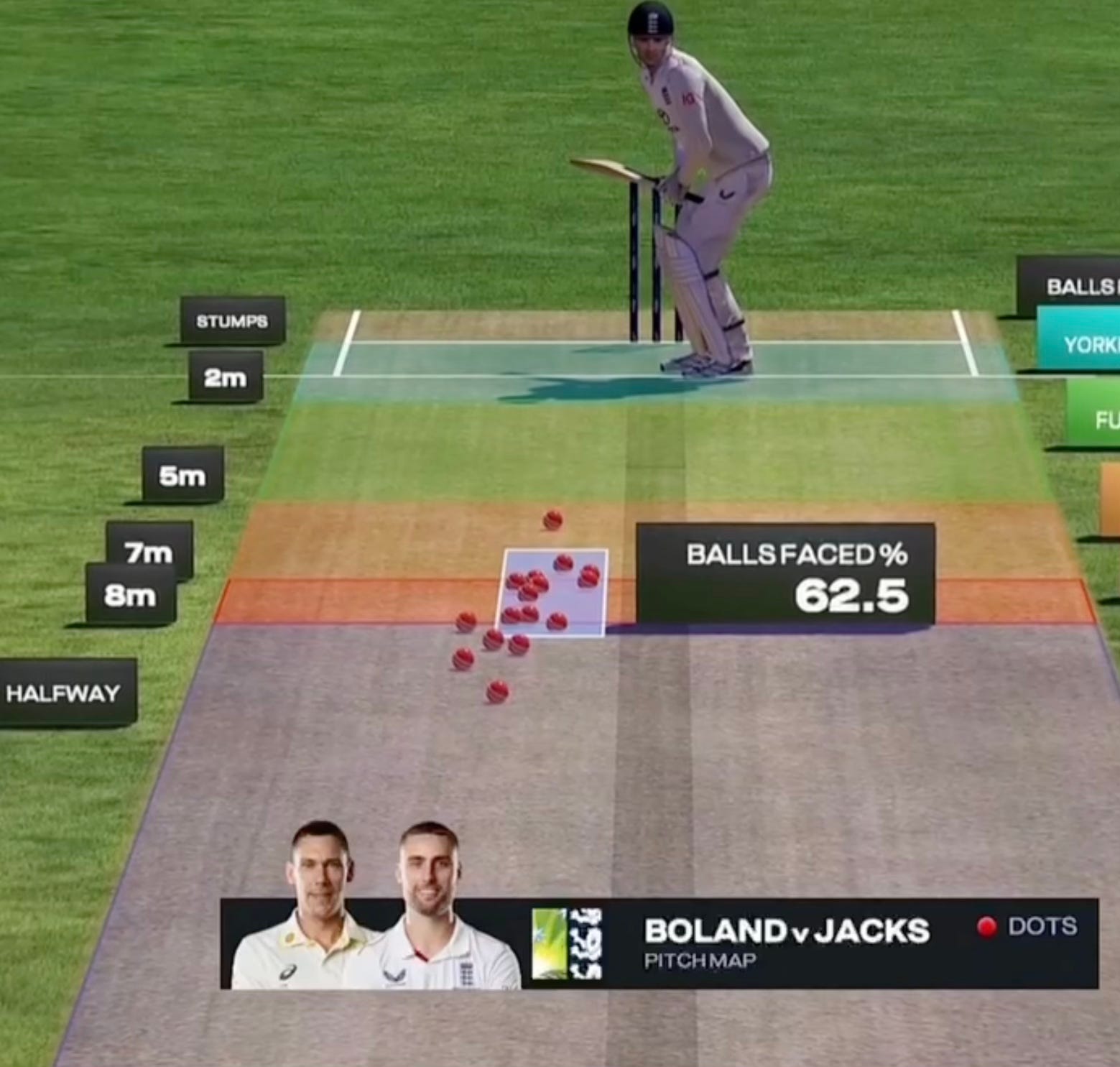
Not long ago, I wrote about how length dictates the course of Test cricket, and Australia proceeded to underline that point emphatically. On a surface with few real demons, they were ruthless in their execution - bowling to their fields, hitting the same areas relentlessly, and methodically wearing down the English batters. Scott Boland was particularly exemplary against Will Jacks, 62 per cent of his deliveries landed on a handkerchief-length area, and even those that missed were not far off. Later, he produced a wobble-seam delivery that jagged back 11 centimetres to demolish Brydon Carse’s stumps.
It wasn’t just Boland. Nathan Lyon, returning to the side, looked as accomplished as ever. His control of length was excellent, but it was the subtle variations of drift and overspin that ensured he relentlessly made the batters think. Most impressive of all, though, was captain Pat Cummins. Having initially been ruled out for three to four months, he returned quicker than expected and was consistently touching the 140s. He didn’t operate in Wagner-esque marathon spells, but his impact was decisive. Against Zak Crawley, he delivered an absolute peach, before expertly setting up Joe Root. He drew Root in with a sequence of in-duckers and then found the outside edge to slip.
By comparison, even England’s standout bowler, Jofra Archer, was operating some distance below that level. Despite bowling well in patches, Archer appeared to receive a stern word from Ben Stokes after dismissing Mitchell Starc, seemingly for leaking a boundary with a short, wide delivery when the plan was clearly to attack the stumps. It was a small moment, but a telling one. Experts often say Test series are won by bowlers, which is why I predicted a 3–1 Australia victory before the first ball was bowled. With nothing going England’s way, the prospect of a 5–0 drubbing no longer feels far-fetched.
Where do England go from here?
The very thought of a whitewash inevitably brings back memories of India’s disastrous tours of England and Australia in 2011. The parallels are hard to ignore. In both cases, the visitors lost a key strike bowler early in the series. Zaheer Khan pulled up with a hamstring injury on Day 1 and was ruled out for the remainder of the tour, similar to Mark Wood’s absence has hurt England.
The imbalance in bowling resources is another familiar theme. On that 2011 tour, the home attack boasted well over 500 Test wickets, while Australia’s current group has amassed more than 1,700 international scalps. India, meanwhile, were left relying on Praveen Kumar in just his second Test series, alongside Ishant Sharma and S. Sreesanth, who together had around 150 Test wickets between them. England find themselves in a similar position now, fielding an attack made up largely of bowlers with 30 to 70 Test wickets apiece.
Even the batting comparisons hold. In 2011, India’s otherwise formidable batting line-up failed to deliver with any consistency, and England’s senior batters have similarly struggled to assert themselves when it matters most.
If there is one crucial difference, though, it lies in context. India in 2011 were carrying several aging stars, and the need for transition was glaring - heads inevitably had to roll. That is not quite the case with this England side. The talent is younger, the ceiling higher, and the sense is less of decline and more of something (or everything) misfiring at the wrong time.
So where do England go from here?
From a batting standpoint, England unquestionably have the talent. There may be a couple of positions that could benefit from fresh faces, Zak Crawley and Ollie Pope chief among them, but beyond that the solution is not wholesale change. It is refinement. England need to optimize their risk-taking, execute more consistently, and learn to bat in gears, particularly on demanding surfaces like Brisbane. Rishabh Pant offers a useful reference point. His is a brand of cricket England readily recognize, yet he is often willing to play within himself, taking a few deliveries to settle unless the pitch is a lottery or the game demands immediate aggression.
England do not even need to look that far for examples. Travis Head, their opposite number, provided a timely lesson in Adelaide. Despite his reputation for eye-catching stroke play, Head reined in his instincts and showed considerable patience, especially when England targeted his ribs. I am no great admirer of Mark Waugh as a commentator, but he was right to note that this hundred bore little resemblance to the usual “Travball”. Instead, it had the discipline of a proper opener’s innings, a point borne out by the data.
Joe Root and Ben Stokes have demonstrated the ability to shift down a gear in this series. Harry Brook and Will Jacks have attempted to do the same and should look to improve with better execution. Ben Duckett and Jamie Smith, however, are two others who would benefit from developing this aspect of their batting. Beyond that, England may not need a dramatic overhaul - just a better understanding of when to push and when to absorb.
England’s young bowling attack will need time and experience to develop consistency. I firmly believe that bowlers need to deliver upwards of 5,000 first-class balls to truly understand their natural lengths and master the subtleties of their craft. What they need is sustained guidance, not constant chopping and changing. Yet England have appointed a third bowling coach in the past 12 months, a level of turnover that would make Pakistan proud.
The absence of a top-quality spinner compounds the problem. In hindsight, Liam Dawson could have travelled with the squad over the last few years, providing both backup and exposure. While ICC events impose squad-size limits, top teams can, and often do, carry larger contingents for test tours to ensure bowlers gain crucial match practice. That kind of planning could have provided cover for a left-field selection like Shoaib Bashir.
Longer-term, England need to invest in spinner-friendly surfaces. Ideally, every county should maintain at least one pitch that is allowed to dry out and offer turn, creating conditions where young spinners can practice and thrive. The ECB has faced similar challenges before in producing batters capable of handling spin, and now it is time to address the gap from a bowling perspective. Without that infrastructure, England risk producing talented bowlers who are technically proficient but never fully battle-tested in the conditions that truly test their craft.
Agree completely! Even though I'm a card carrying member of the "Anyone But England" camp, I do feel sad for the the level of talent they possess. In Crawley Duckett, Root, Brook and Bethell, they possess a lineup that should succeed anywhere. With Stokes and Smith in the lineup, they effectively play with 13 instead of 11. I think they would be better served by prioritizing the WTC instead of the away Ashes. By sweeping away known frailites accumulated in other series under the carpet, under the excuse of "that's not the style that will work in Australia", they're not improving on their skills. They really don't care about their performance in other parts of the world, so they are now unable to adapt to the evolution of Australian conditions and the intense discipline of the Aussie bowling.